Sankaracharya Matha, Puri — History, Timings & Visitor Guide
Puri’s crowds gather at one address: the Jagannath Temple, its queue, its Grand Road. A short auto ride away sits a much quieter compound that, in a strict institutional sense, outranks almost everything else in the city. The Govardhana Matha — universally known as the Sankaracharya Matha — is one of only four monastic seats founded by Adi Shankaracharya to anchor Hindu philosophy across the subcontinent, and it has been advising the Jagannath Temple’s own ritual council for centuries.
Most visitors to Puri never hear of it. That is largely because it asks nothing of you — no queue, no crowd, no spectacle — which is exactly what makes it worth the twenty minutes.
One of Four Seats
In the early medieval period, Vedic tradition in India was fractured — regional schools pulling in different directions, with no shared centre holding the philosophy together. Adi Shankaracharya’s response was structural rather than purely doctrinal: he travelled the length of the subcontinent, and divided it into four cardinal zones, placing a monastic seat — an Amnaya Peetham — at each corner.
Puri’s matha was designated the Eastern Peetham, under the name Govardhana Matha. Traditional regional chronology places its founding in the 8th century CE, alongside its three counterparts at Dwarka (west), Sringeri (south) and Badrinath/Jyotirmath (north). Each of the four was given its own Veda, its own philosophical maxim, and its own line of successors — a structure built to outlast any one teacher.
For the Govardhana Peetham, those identifiers are specific:
| Element | Assignment |
|---|---|
| Veda | Rigveda |
| Mahavakya | Prajñānam Brahma — “Consciousness is the Supreme Being” |
| First Shankaracharya | Padmapadacharya, ordained directly by Adi Shankaracharya |
| Presiding deities | Lord Govardhan-nath (Krishna/Vishnu) and Goddess Vimala (Bhairavi) |
The line continues today under the title Jagadguru Shankaracharya — the title that gives the matha its everyday name. The current head, by tradition counted as the 145th in the lineage, is Swami Nischalananda Saraswati, who has led the seat since the early 1990s.
A Jurisdiction the Size of a Subcontinent
On paper, the Govardhana Peetham’s spiritual authority extends across most of eastern and northeastern India — Odisha, West Bengal, Bihar, Jharkhand, Chhattisgarh, Assam and the smaller northeastern states, reaching as far as Rajahmundry in the south and Prayagraj in the north, and continuing beyond India’s borders into Nepal, Bhutan and Bangladesh.
That is a large claim for a modest compound in a Puri backstreet to carry, and it is worth reading as an inherited framework rather than a description of daily administration — a map drawn a thousand years ago, still cited today. What is not in question is the matha’s real, working relationship to Puri’s own temple: the sitting Shankaracharya heads the Mukti Mandapa, the scholarly council of the Jagannath Temple, and is the figure whose word settles ritual disputes and calendar questions for the temple next door. That is a functioning role, not an honorary one.
The Vimala Connection
The matha’s grounds overlap with the Vimala Temple, and this is where the Sankaracharya Matha stops being a philosophy school and becomes something closer to a pilgrimage site in its own right.
Vimala is counted among the 51 Shakti Peethas — the pan-Indian network of sites said to mark where a part of the goddess Sati’s body fell after Vishnu’s Sudarshana Chakra cut it apart, grief-stricken Shiva carrying the body across the sky. Tradition places the fall of her navel here, which is what gives this corner of Puri its standing in Shakta as well as Vedantic tradition — two quite different threads of Hindu practice converging on the same small site.
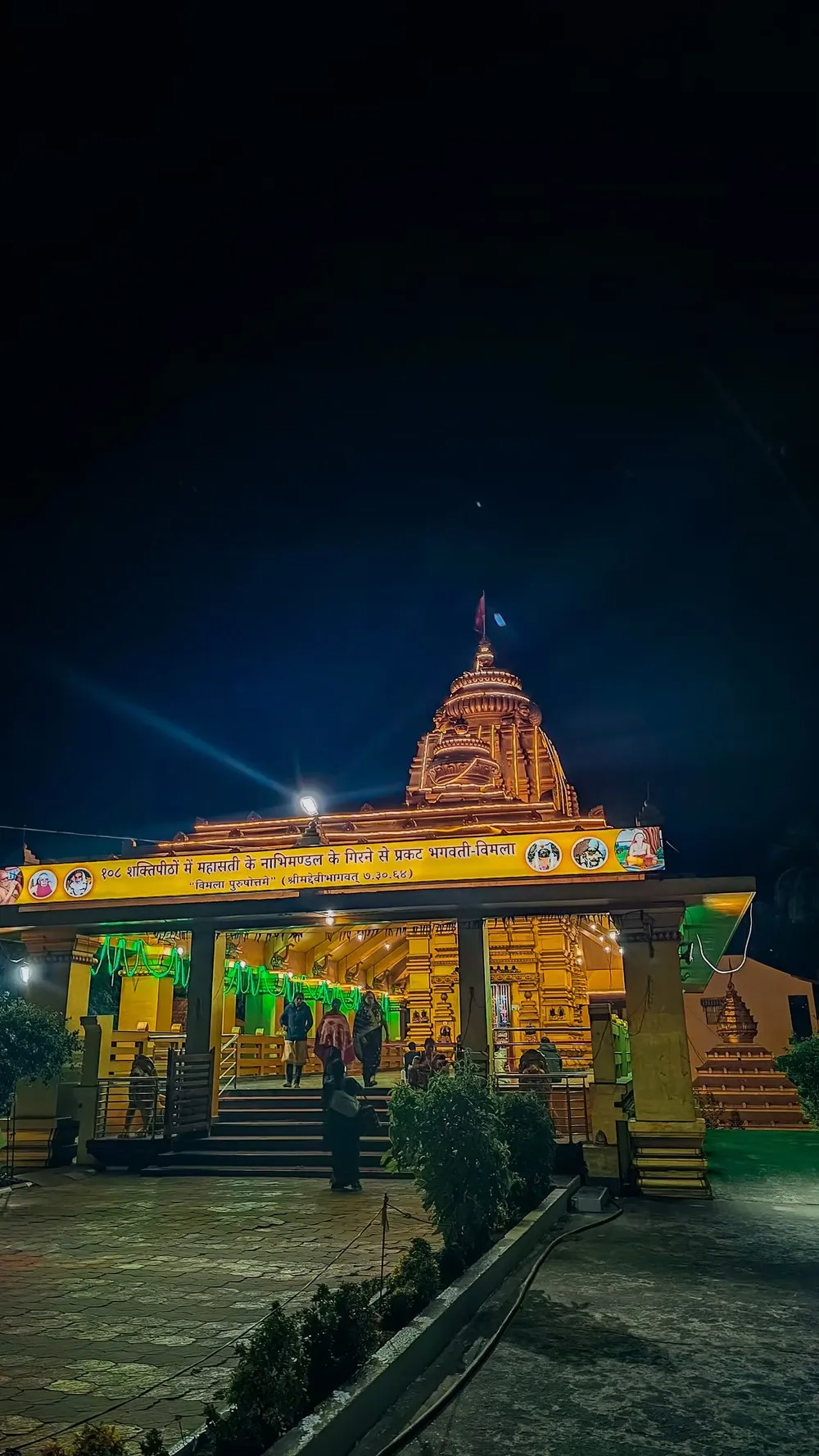
The banner over the shrine states the tradition in Hindi and Sanskrit: that among the Shakti Peethas, Bhagavati Vimala manifested here from the falling of the Mahasati’s navel — a line drawn from the Devi Bhagavata Purana. There is also a temple-specific custom worth knowing: food offered to Lord Jagannath is traditionally considered complete mahaprasad only after a portion has been offered to Vimala. The goddess and the great temple are, in Puri’s own ritual logic, linked.
Inside the Matha
The core of the complex holds shrines to Govardhan-nath and to Ardhanarishwara, the composite Shiva-Parvati form. Pilgrims can also see the Sphatika Linga — a crystal Shiva lingam that tradition holds was personally worshipped by Adi Shankaracharya himself, making it among the oldest continuously venerated objects associated with the founder anywhere in India.
Architecturally the matha keeps to a restrained Kalinga vocabulary, closer to a monastery than a monument — the emphasis throughout is on function over display, which sets it apart from the elaborately carved temples elsewhere in the city.
Beyond worship, the campus runs as a working institution:
| Facility | Purpose |
|---|---|
| Vedic library | Palm-leaf manuscripts, Upanishad commentaries, writings of earlier Shankaracharyas |
| Prabachan Hall | Public discourses and question sessions with the presiding Shankaracharya |
| Charitable hospital | Free or subsidised care for the local community |
| Gaushala | A cow sanctuary maintained by the matha |
| Organic farm and cultural centre | Free Vedic education alongside the farm’s produce |
That combination — library, hospital, farm, free schooling — is closer to what the original Amnaya Peethams were built to be: not shrines to visit once, but institutions meant to run indefinitely.
The Samudra Arati
The matha’s best-known modern practice happens away from its own walls, at Swargadwar beach, every evening at sunset. Disciples of the current Shankaracharya gather at the shore to perform the Samudra Arati — a fire ritual with Vedic chanting, offered to the sea itself, addressed in local tradition as Lord Jagannath’s father-in-law.
It is a comparatively recent addition to Puri’s ritual calendar, started under the current Shankaracharya, and it has become one of the more striking things to witness on the beach after dark — worth timing a sunset walk around, whether or not the matha itself is on your route that day.
Paush Purnima
The matha’s major annual festival falls on the full moon of Paush (typically January), when the Shankaracharya personally leads a procession to the sea to make offerings — sacred cloth, fruit, prayers — directly to the ocean. It draws large crowds, including a genuine international contingent of scholars and pilgrims, and is worth checking against your travel dates if a January trip is on the table.
Timings and Visiting
| Hours | 6:00 AM – 8:00 PM daily |
| Entry | Free (donations accepted for the matha’s charitable work) |
| Best hours | 7:00–9:00 AM for quiet, or 5:30–7:30 PM to see the evening rituals before heading to the beach for Samudra Arati |
| Time needed | 30–60 minutes |
Hours can extend during festivals and public discourses — worth a quick check if your visit is timed around one.
Dress and conduct. Modest, traditional clothing — shoulders and knees covered. Footwear stays outside the shrine areas. Photography inside the core shrines is not permitted, and visitors are expected to keep quiet in the meditation and discourse halls; this is a working monastic institution, not a tourist site, and it is treated that way by everyone else on the grounds.
Getting There
The matha sits about 3.5 km from Puri Railway Station — a short auto or cycle-rickshaw ride, and easy to combine with the Jagannath Temple itself or an evening at Puri Beach, particularly if you time the day to end with the Samudra Arati at Swargadwar. A quiet monastery, a Shakti Peetha, and a sunset ritual on the sand — three very different registers within a single evening’s walk.
Plan your visit