Puri Beach (Golden Beach) — Sunrise Spots, Water Sports & Safety Guide
Puri Beach (Golden Beach), on the Bay of Bengal in the holy city of Puri, is one of India’s most storied stretches of coastline — described in tradition as the shore of the Mahodadhi, the “great ocean,” considered sacred in its own right. Over centuries it has been a mythological gateway, an ancient trading port, and a stage for some of India’s most significant saints, and today it’s also an internationally certified eco-tourism destination: a designated section of the beach holds the prestigious Blue Flag certification, recognising its safety, environmental and cleanliness standards.
Mythological Origins: The Sacred Log & Swargadwar
According to the Skanda Purana, the origin of the Jagannath deities themselves is tied to this shore. King Indradyumna of Malwa, wishing to have images of Jagannath, Balabhadra and Subhadra carved, was directed by a divine voice to the coast at Puri, where a great log of neem wood — the Daru, marked with the conch and discus — is said to have floated ashore. Tradition holds that this log was carried from the beach to the temple site, where it was shaped into the deities worshipped today.
The stretch of beach known as Swargadwar (“Gate to Heaven”) carries its own significance in local tradition, which holds that Lord Jagannath himself descended to earth at this spot. For centuries, devotees have come here for ritual sea-bathing, believed to be spiritually purifying, and the adjoining Swargadwar crematorium is regarded as an especially auspicious place for funeral rites, in the belief that it eases the soul’s passage.
The Maritime Era & the Nolias
Long before it became a tourist destination, this coast was part of a wider network of Kalinga’s maritime trade — Puri is named alongside ports like Tamralipti, Chelitalo and Manikapatna as part of this ancient coastline. From these shores, Odia mariners known as Sadhabas are said to have sailed large wooden vessels (boitas) to Java, Sumatra, Bali, Borneo and Ceylon, trading textiles, spices and gemstones. This maritime memory is kept alive today through Boita Bandana, a ritual held at Kartik Purnima (October–November) in which families float small toy boats of banana bark and paper at dawn, commemorating the voyages of their ancestors.
The beach’s oldest continuous community is the Nolias, a traditional fishing community who have worked this coast for generations, historically using simple rafts made of lashed-together log trunks. Over the last century, the Nolias — recognisable by their triangular straw hats — became the beach’s traditional lifeguards, using their knowledge of the water to warn and rescue visitors caught by Puri’s notoriously strong undercurrents (see Safety Notes below).
Medieval Saints of the Shore
Between roughly the 9th and 16th centuries, Puri Beach became closely associated with several major figures in Indian religious history. Adi Shankara is said to have visited in the 9th century and established the Govardhana Matha nearby; Ramanujacharya’s 12th-century visit is remembered as encouraging the ocean’s holy baths as a space open across caste lines.
In 1510, Guru Nanak Dev, the founder of Sikhism, is said by Sikh tradition to have visited Puri with his disciple Bhai Mardana and, after a misunderstanding kept him from the main temple, sat by the shore in meditation — tradition credits this moment with inspiring his hymn “Gagan mein thaal” (“The sky is the platter…”). The Baulimatha near Swargadwar commemorates this visit and today houses the Guru Granth Sahib alongside depictions of Lord Jagannath.
In the 16th century, the Vaishnava saint Chaitanya Mahaprabhu spent his final years in Puri, and is remembered in Vaishnava tradition as often entering the waves of the beach in states of spiritual ecstasy (Bhava Samadhi) — an image that shaped how the beach came to be seen not only as a place of pilgrimage, but of devotional expression.
From Colonial Sanatorium to Modern Beach Town
After the British occupation of Odisha in 1803, colonial officials seeking relief from Calcutta’s humidity discovered Puri’s sea breeze and began using it as a health retreat. The real shift toward tourism came in 1902, when the Bengal Nagpur Railway extended a line to Puri, opening the town to travellers from Calcutta. The railway company built the BNR Hotel overlooking the beach (still standing as a heritage property) and laid early stretches of what is now Marine Drive, establishing much of the seaside infrastructure the town still relies on.
After independence in 1947, Puri Beach shifted from an elite retreat into a widely accessible destination for families from across eastern India, a role it continues to play today.
Sand Art, Festivals & the Blue Flag Era
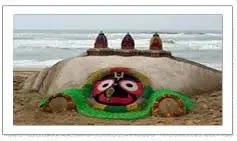
Puri Beach holds a distinctive place in Indian art through sand art — tradition traces the practice back to the medieval poet Balaram Das, said to have carved a sand temple on the beach after being denied entry to the main chariot procession, though the modern art form is most associated with Sudarshan Pattnaik, whose large sculptures on themes of environment and social issues have brought international attention to the beach. Since the 1990s, the annual Puri Beach Festival in November has added classical Odissi performances, folk music and handloom exhibitions to the beach’s cultural calendar.
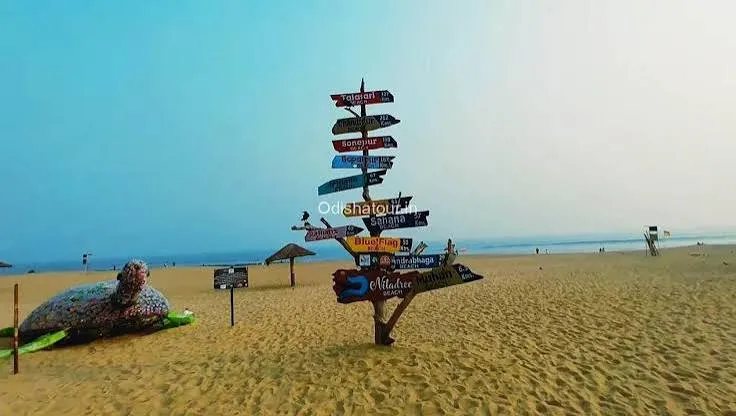
This cultural profile sits alongside a more recent environmental milestone: on 11 October 2020, a designated section of Puri’s Golden Beach received Blue Flag certification from the Foundation for Environmental Education (Denmark) — recognising standards including regulated waste management, continuous water-quality testing, accessible eco-friendly pathways, and certified lifeguard coverage.
Magical Sunrise Spots
Because the coastline faces east over the Bay of Bengal, it offers a breathtaking backdrop as the sun comes up over the horizon.
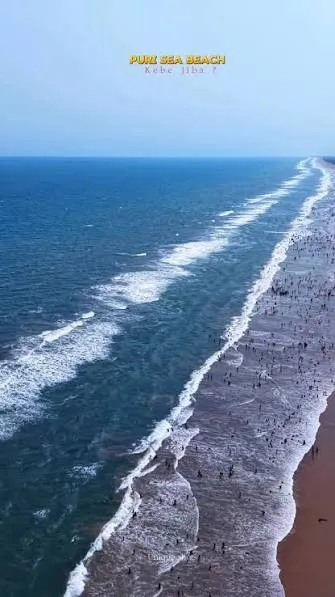
The Blue Flag Enclosure: This is the best spot if you prefer a peaceful, garbage-free morning walk. There is a small entry fee of ₹20 per person (valid for 3 hours) and ₹10 for two-wheelers. It features manicured jogging tracks and clean seating zones.
Swargadwar Beach Stretch: Located just outside the paid enclosure, this zone lets you watch traditional fishermen launch their wooden boats into the morning waves. It is incredibly atmospheric but much more crowded.
Water Sports & Activities
While water sports at Puri have traditionally been limited due to strong sea currents, seasonal activities thrive during the calm weather months from October to February.
Thrilling Rides: You can find vendors organizing banana boat rides, speed boating, jet skiing, and parasailing.
Pricing: Rates generally range from ₹500 to ₹2,000 depending on the specific activity and your bargaining skills.
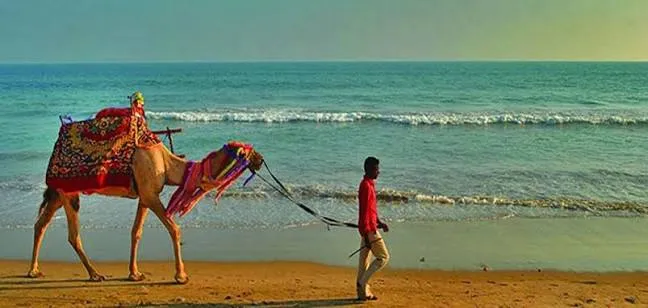
Leisure Options: If you prefer staying dry, you can enjoy camel and horse rides along the shoreline or rent beach chairs and umbrellas for ₹20 to ₹50 per hour.
Crucial Safety Notes
The Bay of Bengal looks inviting, but it demands strict caution:
Beware the Undertow: Puri Beach is notorious for its severe undertow and strong undercurrents. The retreating waves pull back with immense force and can easily knock down adults or drag children out into deep water.
Swim in Designated Zones: Only swim inside the designated safe-swimming boundaries marked by flags in the Blue Flag zone, where professional lifeguards are always on active duty.
Nulias (Local Lifeguards): If you plan to bathe in the open non-Blue Flag sections, look for local fishermen known as Nulias who wear distinct conical hats. They act as traditional lifeguards and can guide you away from sudden drops in the sandy ocean floor.
Post-Swim Facilities: Avoid staying in wet clothes. You can access clean, public changing rooms and freshwater shower facilities inside the maintained beach zone for ₹50.
Plan your visit