Jagannath Temple, Puri — Complete History, Timings & How to Reach
The Shree Jagannath Temple of Puri, in Odisha, is one of India’s major pilgrimage centres and is traditionally counted among the four Char Dham pilgrimage sites. The temple is dedicated to Lord Jagannath, worshipped together with his elder brother Balabhadra and sister Subhadra. The present monumental temple dates to the 12th century, with the Ganga dynasty king Anantavarman Chodaganga Deva traditionally credited with its construction. The temple is also the centre of the wider Jagannath tradition, whose influence extends far beyond the temple itself into Odisha’s festivals, food, literature, music, dance and social culture.
Origins & Legends
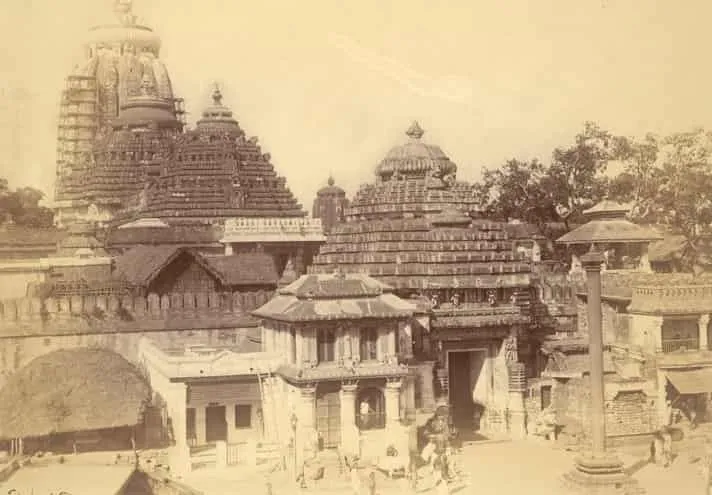
According to tradition, the origins of Jagannath worship predate the present stone temple. One account tells of King Indradyumna, who sought to worship a mysterious form of Vishnu associated with the sacred region of Purushottama Kshetra. Another strand of the tradition involves Nilamadhava, a form of the deity worshipped by the Sabaras — one of Odisha’s indigenous communities, with whom the Jagannath tradition preserves strong links to this day. This connection is often cited as a reason Jagannath worship is seen as a distinctive synthesis of different religious and cultural traditions in Odisha. According to the traditional narrative, the deity eventually became associated with the wooden forms of Jagannath, Balabhadra and Subhadra.
These are traditional accounts, an important part of Jagannath religious culture — worth understanding as such, rather than as established archaeological history.
Puri itself has been known by several names over the centuries, including Purushottama Kshetra, Purushottama, Sri Kshetra and Jagannath Puri. The name Purushottama Kshetra is historically documented: a record from the reign of Anangabhima III, dated 1229–30 CE, refers to the place by this name. The growth of the Jagannath temple transformed Puri into a major centre of Vaishnavism and pilgrimage.
Construction & the Ganga Dynasty
The present temple belongs principally to the 12th-century Ganga period. Government sources identify Anantavarman Chodaganga Deva of the Eastern Ganga dynasty as the ruler associated with construction of the present temple, which went on to receive additions and modifications over later centuries — Odisha Tourism notes that construction on the complex continued until approximately the 16th century.
It’s worth keeping the timeline distinction clear, since the Jagannath tradition itself is far older than the present building:
Ancient Jagannath tradition → earlier forms of worship → the 12th-century Ganga temple → later additions and developments → today’s Sri Mandir
The Eastern Ganga rulers played a major role in establishing Puri as a major religious centre. The temple was never simply a monument — it became the centre of a large religious and administrative system involving priests, servitors, rituals, festivals, land endowments, food preparation and pilgrim services, an institutional structure that tied the Jagannath tradition deeply into Odisha’s political and cultural history.
Temple Architecture
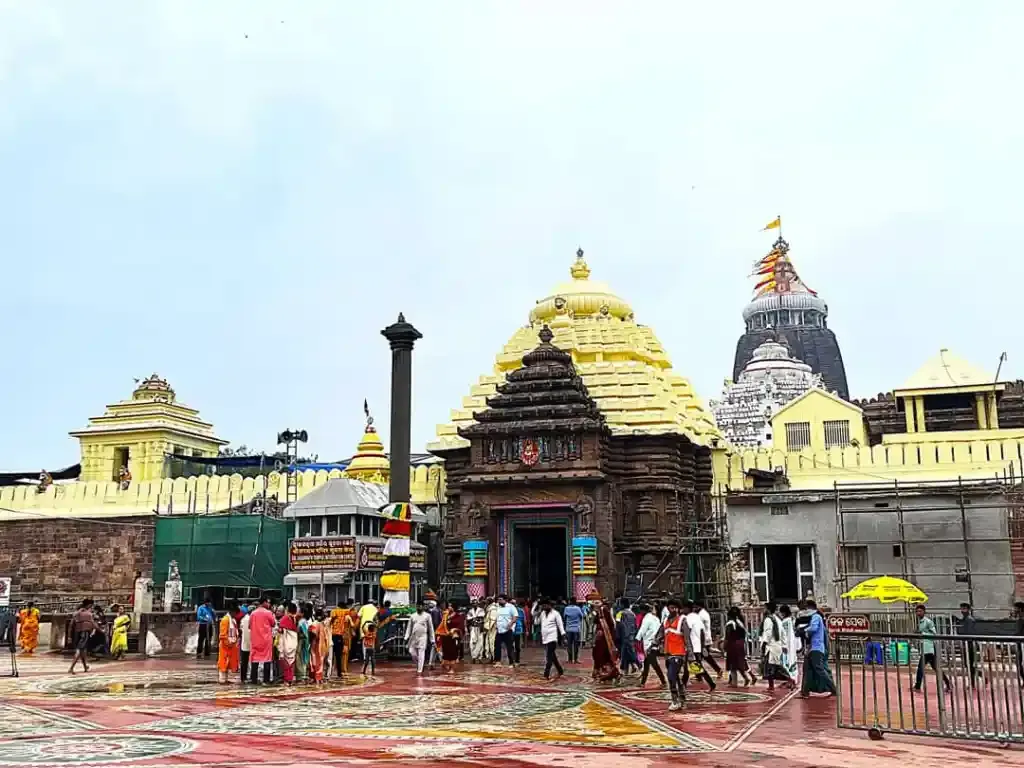
The temple is a significant example of Kalinga temple architecture. According to the Puri district government website, the main temple stands on a raised platform and rises to approximately 65 metres.
The principal architectural sequence consists of four structures, arranged along an east-west axis:
- Vimana / Bada Deula — the sanctum and main tower
- Jagamohana — the assembly/audience hall
- Natamandira — the hall associated with ritual and performance
- Bhogamandapa — the hall associated with offerings
The complex is enclosed by two concentric boundary walls: the inner Kuruma Bheda, and the outer Meghnad Pachira. The main entrance is the Singhadwara (Lion Gate) on the eastern side, with three further gates completing the traditional four: Vyaghradwara (Tiger Gate, west), Hastidwara (Elephant Gate, north), and Ashwadwara (Horse Gate, south) — each associated with a cardinal direction as part of the temple’s symbolic layout.
The Deities & Nabakalebara
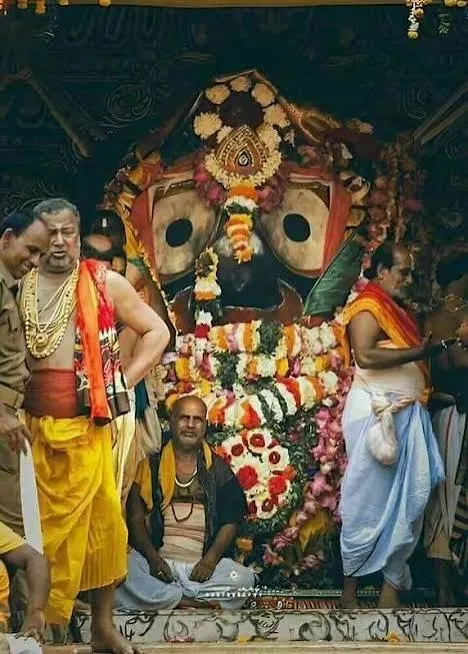
Worship centres on three deities — Lord Jagannath, his elder brother Lord Balabhadra, and their sister Devi Subhadra — seated together on the Ratna Simhasana, traditionally described as their jeweled throne.
Unlike most major Hindu temples, where stone images are the norm, the principal Jagannath deities are traditionally made from sacred wood. This is connected to the Nabakalebara tradition — literally, a renewal of the deities’ physical forms — in which the old wooden images are ceremonially replaced with new ones through elaborate ritual procedures. Kakatpur’s Goddess Mangala is traditionally connected with the search for the sacred trees used in the process.
Nabakalebara doesn’t happen every year; it is tied to particular calendrical circumstances involving an additional lunar month. In broad terms, the process moves through identifying the sacred trees, bringing the wood in under strict ritual rules, creating the new forms, transferring the deities’ sacred life into them, and ceremonially retiring the old forms — a cycle that represents renewal while maintaining continuity with the ancient worship.
Daily Worship & Food Traditions
Worship at the temple is far more than a single daily prayer — it follows an extensive ritual schedule performed by different categories of servitors, covering the awakening of the deities, their bathing and dressing, food offerings, public darshan, and evening and night rituals. The exact sequence and timings can change, so rather than publish a fixed daily ritual schedule here, we’d recommend checking the latest official temple information before planning a visit around specific ceremonies.
One of the temple’s most famous traditions is Mahaprasad — food prepared in the temple kitchen and offered to the deities, and a cornerstone of Odisha’s religious and culinary culture. Odisha Tourism describes the Mahaprasad tradition and the temple’s large-scale cooking system as one of Puri’s most distinctive cultural features; devotees can traditionally obtain Mahaprasad at Ananda Bazaar.
Related to this is Chhappan Bhog, traditionally understood as an offering of 56 varieties of food, described by the Odisha Tourism brochure as a daily sacred offering and an important part of Puri’s cultural identity.
Rath Yatra & the Festival Calendar
The most famous festival associated with Jagannath is the Rath Yatra, during which Jagannath, Balabhadra and Subhadra leave the temple and travel on three enormous chariots:
| Deity | Chariot |
|---|---|
| Jagannath | Nandighosha |
| Balabhadra | Taladhwaja |
| Subhadra | Darpadalana |
The festival centres on the deities’ journey from the Sri Mandir along the Bada Danda to the Gundicha Temple — read our full guide to Gundicha Temple — followed later by the return journey, the Bahuda Yatra.
Before the chariots move, the deities are ceremonially brought out of the temple in a procession called Pahandi, carried in a distinctive rhythmic movement while devotees gather along the Bada Danda. Another key ritual is Chera Pahara, in which the Gajapati Maharaja of Puri ceremonially sweeps the chariot platform — Odisha Tourism identifies it as one of the important Rath Yatra rituals, representing humility and the idea that service to the Lord transcends worldly status.
After the deities return to Puri, further rituals follow, including Suna Besha, when they are decorated with elaborate gold ornaments — one of the most visually spectacular stages of the Rath Yatra cycle.
A separate major festival, Snana Yatra, sees the three deities ceremonially bathed with 108 pitchers of water. Afterward, they are traditionally believed to fall ill and enter a period called Anavasara, during which they aren’t available for normal public darshan. This period is closely connected with the Alarnath Temple at Brahmagiri, where devotees traditionally go during Anavasara — the Puri district government describes this association with Chaitanya Mahaprabhu.
Chaitanya Mahaprabhu’s Association with Puri
Puri became an important centre for Chaitanya Mahaprabhu, the influential Vaishnava saint associated with the Gaudiya Vaishnava tradition, whose presence had a major influence on the devotional culture surrounding Jagannath. The wider history of Puri also includes visits and associations with other saints and philosophers — among them Adi Shankaracharya, Ramanuja, the Madhva tradition, and Guru Nanak — according to the Puri district’s historical account.
Temple History Through the Centuries
The temple’s history includes repeated periods of political conflict. According to a Puri district government study based on temple historical records, the temple experienced 18 invasions across its history, beginning with the traditional account of Raktabahu and continuing through various medieval and early-modern rulers. As with the temple’s origin stories, this is an area to read carefully — these accounts come from the Madala Panji (the temple’s historical chronicle) and official government sources, rather than being independently verified archaeological fact in every detail.
One of the most significant disruptions came in 1568, following the defeat of the Gajapati ruler Mukunda Deva. The Puri district study identifies this as the invasion associated with Kalapahad, during the political transition involving the Afghan ruler of Bengal. The temporary removal and later restoration of the deities during periods of danger is a recurring thread in Jagannath tradition.
After the fall of the independent Gajapati kingdom, Ramachandra Deva I of Khurda became a central figure in restoring Jagannath worship, re-establishing the three principal deities at Puri — historical sources describe this as the basis for the close association later Khurda rulers held with the title and institution of the Gajapati.
Parts of Odisha subsequently came under Mughal authority, and the Jagannath institution continued to operate through changing political circumstances, with further attacks and episodes of the deities being moved for protection — the Puri district’s historical study documents several such episodes between the 16th and 18th centuries. The Marathas gained control of Odisha in the 18th century; according to the Government of Odisha’s historical account, Jagannath worship continued through both the Mughal and Maratha periods, with the Maratha administration also becoming involved in temple management.
The British occupied Odisha in 1803, after which the temple’s administration came under British involvement and changed arrangement several times, though the Raja of Khurda retained an important role in temple affairs even as political power shifted.
The modern legal framework dates to the Shri Jagannath Temple Act, 1955 — per the Government of Odisha’s RTI material, the Act was created to provide a structure for administering the temple and its endowments, marking the transition from historical royal administration to today’s institutional system.
Entry Fee & Timings
Entry Fee: Free. There is no fee charged to enter the temple complex or for standard darshan.
Timings: The temple is generally open daily from 5:00 AM to 11:00 PM. However, regular public access is temporarily closed during certain afternoon rituals, typically between 1:00 PM and 4:00 PM.
How to Reach
By Air: The nearest airport is the Biju Patnaik International Airport in Bhubaneswar, located about 60 km away. From the airport, you can easily hire a taxi, take a state bus, or catch a train to Puri.
By Rail: Puri Railway Station (PURI) is a major railhead well-connected to all principal Indian cities like Kolkata, Delhi, Mumbai, and Chennai.
By Road: Puri is smoothly connected via national highways. Regular public and private buses, as well as cabs, ply daily from Bhubaneswar, Cuttack, and Konark.
Plan your visit