Ram Mandir, Bhubaneswar — History, Aarti Timings & Visitor Guide
Most visitors meet the Ram Mandir by accident. It sits on Janpath at Kharvel Nagar, in the middle of Bhubaneswar’s busiest commercial stretch, and its red towers rise directly out of a district of shops, offices and traffic. You do not go looking for it down a quiet lane the way you do with the old-town temples. It is simply there, in the middle of the working city.
That location tells you most of what you need to know about it. This is not an archaeological site. It is a functioning neighbourhood temple in a modern commercial district, busy in the evenings, free to enter, and used daily by people who live and work around it.
A Temple From 1979
Bhubaneswar’s fame rests on the tenth and eleventh centuries. The Ram Mandir belongs to the twentieth. Its ritual foundation was formally established on 27 June 1979 — a little under fifty years ago, which in this city makes it almost aggressively new.
It was built and is still run by a private trust, not by the Archaeological Survey of India and not by the state endowments department. The practical consequences for a visitor are immediate and all positive: entry is free, there is no ticket counter, the complex is actively maintained rather than merely conserved, and the grounds are swept and planted rather than fenced off.
The dedication is to Lord Rama, Goddess Sita and Lord Lakshmana, whose marble images occupy the central sanctum.
Seven Shrines in One Compound
What surprises people who walk in expecting a single temple is that the compound holds seven separate shrines. The main one is Rama’s; arranged around it are temples to:
- Shri Panchmukhi Hanuman — the five-faced form of Hanuman
- Lord Shiva
- Goddess Durga
- Lord Ganesha
- Rani Sati
That last one is worth noticing. Rani Sati is a devotional figure venerated largely in Rajasthan and by Marwari communities across India, and a shrine to her is an unusual thing to find in Odisha. Its presence here is a quiet marker of who founded and funded the trust, and of how Bhubaneswar’s commercial district grew in the second half of the twentieth century.
The practical effect of seven shrines is that a visit is a circuit rather than a single darshan queue. Most visitors work their way around the subsidiary temples before or after the main sanctum, which is why people spend longer here than the building’s size would suggest.
A landscaped lawn and garden fill the front courtyard, and unusually for a city-centre temple there is genuine room to sit. In the evenings it functions as much like a public square as a religious compound.
Modern Date, Ancient Language
Here is the interesting thing architecturally, and it is the opposite of what people expect from a temple built in 1979.
The Ram Mandir did not adopt a modern idiom. It was built in the traditional Kalinga vocabulary — the same one used at Lingaraj a thousand years earlier. The towers are recognisably Odia: a tall curvilinear rekha spire over the sanctum, stepped pyramidal pidha roofs over the subsidiary structures, crowned with ribbed discs and finials. The entrance is a painted torana arch topped with lions, flanked by figural sculpture.
The difference is in the surface. Where the ancient temples are bare carved sandstone weathered to grey and ochre, the Ram Mandir is finished in strong red with the decorative work picked out in vivid blues, greens, pinks and gold. It reads at a distance as a red temple — which is exactly how locals describe it.
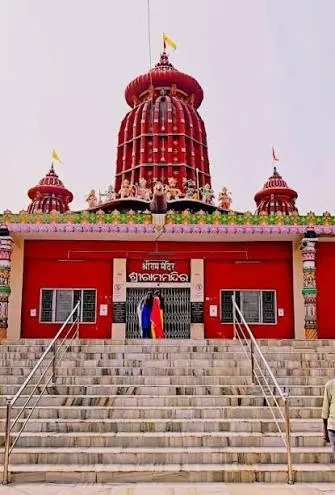
The contrast with the city’s other modern temple is instructive, and if you have time for both it is worth seeing them on the same trip. The ISKCON temple at Nayapalli, built over roughly the same period, went the other way — white, tiered, consciously contemporary, visibly a temple of its own century. The Ram Mandir chose continuity instead. Two twentieth-century temples in one city, answering the question of what a new temple should look like in completely opposite ways.
Timings and Aartis
The temple runs a split day with a long midday closure, which is the single most important thing to plan around.
| Morning darshan | 5:30 AM – 12:00 PM |
| Evening darshan | 4:30 PM – 9:30 PM |
| Morning aarti | 9:30 AM |
| Evening aarti | 7:00 PM |
| Entry | Free |
Arriving at 1 PM or 3 PM means finding it shut. This catches out visitors working through a city itinerary in the middle of the day, and it is worth building the afternoon around.
Timings at active temples shift with the festival calendar — confirm before travelling if your plan depends on a particular aarti.
When to Go
Time of day. Between 4:30 PM and 8:00 PM. The temple fills after work, the exterior lighting comes on against the red towers, and the 7:00 PM aarti is the high point of the day. A morning visit is perfectly pleasant but you will see a much quieter building.
Season. October to March, as with everything in Bhubaneswar. Between April and June the courtyard is uncomfortable and the stone underfoot gets hot once shoes are off.
Avoiding crowds. Tuesday and Thursday mornings are the quietest slots in a normal week. Sundays and festival days bring the heaviest footfall by a wide margin.
Ram Navami and the Festival Calendar
The temple’s biggest day is Ram Navami, in March or April, marking Rama’s birth. The compound is decorated throughout, there are chariot processions, continuous bhajan singing, and community feeding at scale. If your trip coincides with it, this is the most vivid thing happening in Bhubaneswar that week — and worth planning around rather than stumbling into, since the crowds are substantial.
Other festivals observed here with real energy include Janmashtami, Vivah Panchami — which marks the marriage of Rama and Sita, and is naturally significant at a temple dedicated to them both — and Dussehra.
Practical Notes
Entry is free and there is no photography charge, though as at any active temple you should ask before photographing the sanctum or the images themselves.
Footwear comes off before entering the shrines. There is a place to leave it.
Dress modestly — shoulders and knees covered.
Time needed: around 45 minutes to walk the full circuit of seven shrines at a reasonable pace, or an hour if you are staying for the aarti.
Accessibility: the main shrine is approached by a flight of steps, which is worth knowing if you are travelling with anyone who finds stairs difficult.
Getting There
The temple is at Kharvel Nagar on Janpath, in the commercial core of the city — roughly 2 km from Bhubaneswar Railway Station and about 4 km from the airport. It is one of the easiest temples in Odisha to reach: any auto driver in the city knows it, and it is walkable from much of the central hotel district.
Because it sits in the middle of town rather than out at the edges, it slots into a day more easily than most. A natural Bhubaneswar temple circuit runs the ancient sites in the morning — Lingaraj, Rajarani and Mukteswara in the old town — then picks up the Ram Mandir on the way back through the centre in the evening, timed for the 7:00 PM aarti. That gives you a thousand years of Kalinga architecture before lunch and a living temple after dark, which is a better day than doing either on its own.