ISKCON Temple, Bhubaneswar — History, Aarti Timings & Visitor Guide
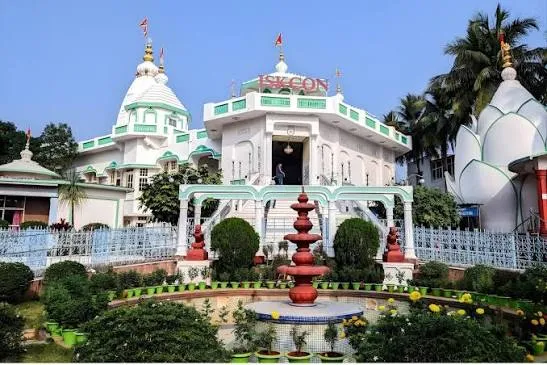
Bhubaneswar is a city of stone. Its reputation rests on sandstone towers carved a thousand years ago, and almost everything a visitor is told to see was finished before the thirteenth century. The ISKCON temple in Nayapalli belongs to none of that. It is white, it is modern, it opened in 1991, and it sits on a busy stretch beside National Highway 16 rather than in the quiet lanes of the old town.
It is also, on most evenings, considerably more alive than any of the ancient monuments — and for a large category of visitor it is the single most important temple in the city, for one specific reason covered further down this guide.
Srila Prabhupada’s Last Project
The temple’s official name is the Sri Sri Krishna Balarama Temple, and its story starts not with a building but with an instruction.
In 1975, A.C. Bhaktivedanta Swami Prabhupada — the founder-acharya of the International Society for Krishna Consciousness — designated Bhubaneswar as a new ISKCON project. The society’s own records count it as the 108th such project, a number carrying obvious weight in Hindu practice, where 108 governs everything from japa beads to the count of sacred sites.
It carries a second distinction that matters more to the devotees who maintain it: Bhubaneswar is remembered as the last project Prabhupada personally sanctioned before his passing in 1977. Whatever else the temple is, it is treated by its community as a final instruction to be carried out, and that framing explains a great deal about how stubbornly it was built.
A Mud Hut in the Jungle
The disciple given the assignment was Sri Srimad Gour Govinda Swami Maharaja, an Odia-born monk who had met Prabhupada in 1974 and been initiated by him.
It is worth pausing on what Nayapalli was in 1975. Today it is a dense commercial district on a national highway corridor. Then it was undeveloped scrub and jungle on the edge of a much smaller city — no infrastructure, no road worth the name, and no community to draw on.
Gour Govinda Swami arrived with no funding and no construction team. He built a mud hut on the land and lived in it. For the next years he did two things: he preached to the villagers around him, and he translated Prabhupada’s books into Odia, opening the movement’s literature to a language it had not previously reached.
In early 1977, Prabhupada came to see it. He was by then seriously ill, and he stayed in that mud hut with his disciple for seventeen days. During this visit — on Nityananda Trayodashi, in February 1977 — he laid the foundation stone himself, and spoke of the temple becoming a meeting point between Indian tradition and visitors from the West.
He died later that year. The foundation stone was, for a long time, all there was.
Seventeen Years of Building
What followed was not a construction project in any conventional sense. There was no single benefactor and no completion deadline. Funding came from small local donations, gathered slowly, and the work advanced at exactly the speed the money allowed — roughly seventeen years of it.
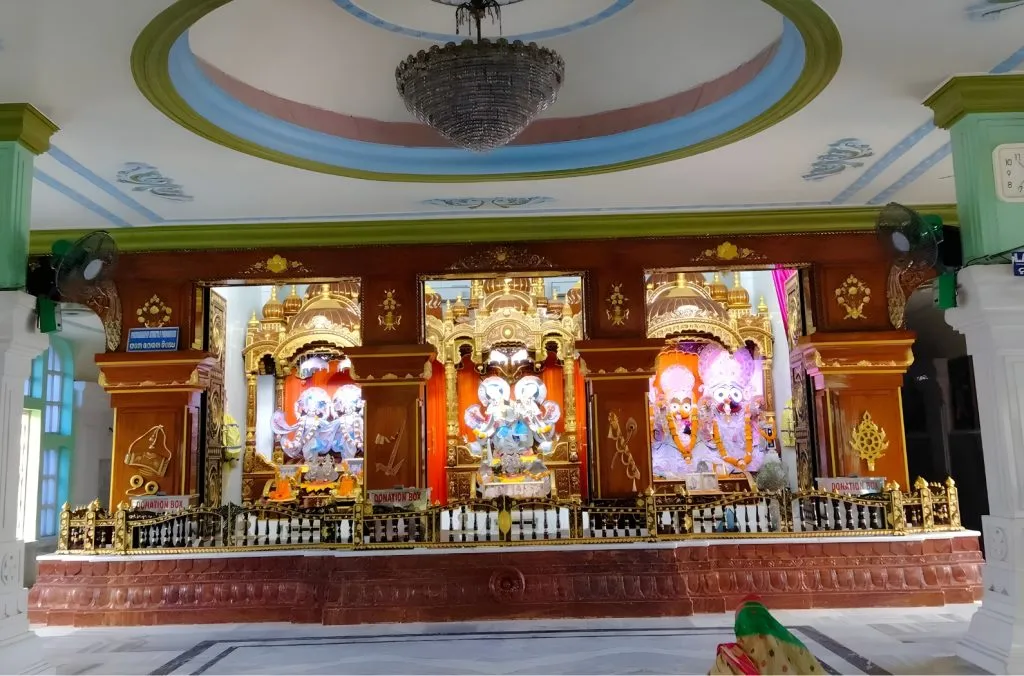
The temple finally opened in 1991, on Lord Nityananda’s appearance day. At the installation, deities were placed across several altars:
- Sri Sri Krishna-Balarama — the temple’s presiding forms, and the source of its formal name
- Sri Sri Radha-Gopinatha
- Sri Sri Gaura-Nitai
- Lord Jagannath, Baladeva and Subhadra — a deliberate and, as the next section explains, consequential inclusion
Gour Govinda Swami lived another five years, dying in 1996. The temple he spent two decades building is the most visible thing he left.
Why This Temple Matters: The Open Door
Here is the thing that makes ISKCON Bhubaneswar genuinely important rather than merely pleasant.
Odisha’s supreme pilgrimage is the Jagannath Temple at Puri. It is the reason a large share of visitors come to this state at all. And entry to it is restricted to Hindus — a centuries-old rule, enforced at the gate, which excludes a great many people who have travelled specifically to see it. Foreign visitors, visitors of other faiths, and at times even people of Indian descent who could not satisfy the gatekeepers have been turned away.
ISKCON Bhubaneswar worships the same three deities — Jagannath, Baladeva and Subhadra — and admits everybody, without condition. Nationality, faith, background and appearance are all irrelevant at the door.
For an international traveller who wants to understand Jagannath devotion rather than read about it, this is the place where that is actually possible. It is why the temple appears on itineraries that would otherwise skip a modern building entirely, and why its congregation on a given evening is noticeably more mixed than anywhere else in the city.
The same openness extends to its teaching. Daily classes on the Bhagavad Gita and Srimad Bhagavatam run in the morning and evening and are open to anyone who sits down.
The Building and the Campus
Architecturally, this is a clean break from the Kalinga tradition standing a few kilometres away. There is no carved sandstone, no rekha deul, no erotic panels, no thousand-year patina. The temple is a white painted structure picked out in pale green, rising in tiers to rounded towers that nod to Odia temple form without reproducing it, with a lotus-inspired massing — the tiers reading as opening petals — that gives the building its distinctive silhouette.
The interior is built for congregation rather than for a single dark sanctum: wide halls, pillars, cool stone floors and room for a kirtan to fill. The altars sit behind carved and gilded wooden frames under a chandelier.
The campus around it has grown into something closer to a small self-contained institution:
| Part of campus | What it is |
|---|---|
| Temple hall and altars | The lotus-form core, with the parikrama path around it |
| Brahmachari ashram | Residential quarters for 150-plus monks and full-time practitioners |
| Three separate kitchens | One for the deities’ offerings, one for resident monks, one for the restaurant |
| Govinda’s Restaurant | Sattvic vegetarian food, cooked without onion or garlic |
| Prasadam hall | Community dining, with capacity in the hundreds |
| Library, gift shop, conference hall | Books, devotional items and event space |
The three-kitchen arrangement is not bureaucratic fussiness. Food offered to the deities is prepared under conditions that cannot be shared with commercial cooking, so the separation is a ritual requirement rather than a logistical one.
The Daily Schedule
This is an active temple running a full monastic day, and it is worth matching your visit to it — arriving between ceremonies means seeing a quiet hall, while arriving during one means seeing the temple as its community experiences it.
| Time | Ceremony |
|---|---|
| 4:15 – 4:45 AM | Mangal Aarti |
| 5:15 AM | Japa — mantra meditation |
| 7:15 AM | Sringar Aarti |
| 8:00 AM | Srimad Bhagavatam class |
| 12:00 – 12:30 PM | Raj Bhoga Aarti |
| 6:30 – 7:30 PM | Sandhya Aarti — the evening ceremony |
| 7:30 PM | Bhagavad Gita class |
| 8:15 – 8:30 PM | Shayan Aarti |
Darshan hours: 4:00 AM – 12:45 PM, then 4:15 PM – 8:30 PM.
Note the midday closure. The sanctum shuts after the Raj Bhoga Aarti and does not reopen until the afternoon, which catches out visitors who arrive at 2 PM assuming a temple is simply open. Plan around it.
Timings at active temples shift with the festival calendar. Confirm before travelling if your visit depends on a particular ceremony.
When to Go
Season. October to February. Bhubaneswar’s summer is severe, and while the temple interior stays cool, the approach and the campus do not.
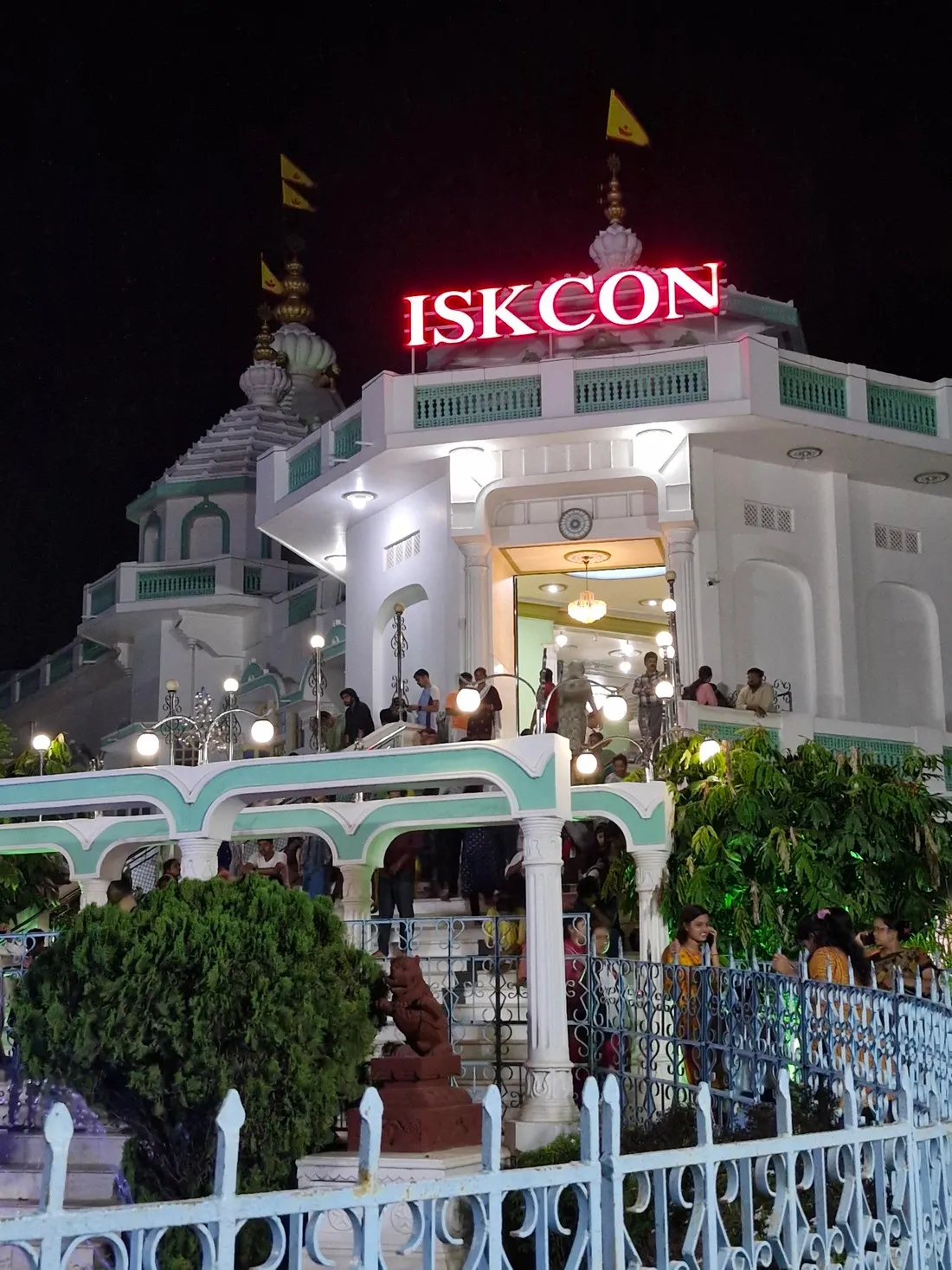
Time of day. If you only go once, go at 6:15 PM. The lights come on across the white facade, the Sandhya Aarti begins at 6:30, and for an hour the hall fills with mridanga drums, karatals and collective chanting. It is the single most atmospheric hour at any temple in Bhubaneswar, ancient ones included — and unlike the carved monuments, it is a thing happening rather than a thing preserved.
Festivals. Krishna Janmashtami, Radhashtami and Ratha Yatra transform the campus completely. Expect large crowds, extended programmes and free prasadam distribution on a serious scale. Book accommodation well ahead for these dates.
Practical Notes
Entry is free. There is no ticket, unlike the ASI-protected monuments elsewhere in the city.
Dress modestly — shoulders and knees covered. Footwear comes off before entering the temple hall; there is a counter for it.
Photography is generally permitted on the campus and grounds, but restrictions often apply to the altars and during ceremonies. Look for signage and ask before photographing the deities.
Eating here is part of the visit. Govinda’s serves full sattvic vegetarian meals, and for many visitors it is the most reliable pure-vegetarian meal in Bhubaneswar. A thali here after the evening aarti is a natural way to close the day.
How long to allow. Ninety minutes if you are timing it around an aarti, forty-five if not.
Getting There
ISKCON sits in Nayapalli, on NH-16, roughly 4 km from Bhubaneswar Railway Station and about 6 km from Biju Patnaik International Airport — closer to both than the old-town temples are, and easy to reach by auto or taxi from anywhere in the city.
It pairs naturally with a half-day of contrast: the ancient stone of Lingaraj Temple and the deity-less Rajarani Temple in the morning, then ISKCON for the evening aarti. One ancient and restricted, one ancient and empty, one modern and wide open — three quite different answers to the same question, all within a few kilometres of each other.