Odisha State Museum & Tribal Museum, Bhubaneswar — A Complete Guide
Odisha State Museum in Bhubaneswar serves as the premier repository of the state’s cultural evolution, featuring dedicated sections that highlight both its indigenous tribal heritage and its ancient maritime dominance.
While the broader Odisha State Museum houses an extensive collection of archaeological artifacts, armor, and rare palm-leaf manuscripts, Bhubaneswar also features the highly specialized Odisha State Tribal Museum (located near CRP Square), which provides an exhaustive, dedicated look at the state’s 62 tribal communities. Together, these institutions preserve the core pillars of Odia identity: the deep inland tribal traditions and the coastal “Sadhabas” (maritime merchants) who sailed across Southeast Asia.
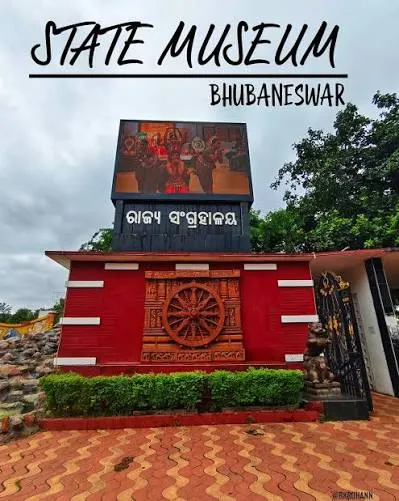
The Odisha State Museum: From College Cabinet to State Repository
The Odisha State Museum’s origins trace back to 1932, when two history professors at Ravenshaw College in Cuttack, Ghanshyam Dash and N. C. Banerjee, began gathering coins, copper-plate grants and sculpted relics from nearby archaeological sites — concerned that local antiquities were otherwise ending up with collectors outside the region. Their collection, initially kept in a departmental cabinet, grew with support from figures like the historian and statesman Dr. Harekrushna Mahatab, and in 1938 the Government of Odisha formally recognised it, establishing it as the Provincial Museum of Odisha under a management committee led by the college principal.
As the state capital shifted from Cuttack to the newly planned city of Bhubaneswar, the museum moved with it: to the Brahmananda building in Old Bhubaneswar around 1945–46 (when it was given State Museum status), then to Patel Hall in Unit I by 1950 as the collection kept outgrowing its space. On 29 December 1957, India’s first President, Dr. Rajendra Prasad, laid the foundation stone for a permanent museum complex at Kalpana Square, which opened to the public in 1960.
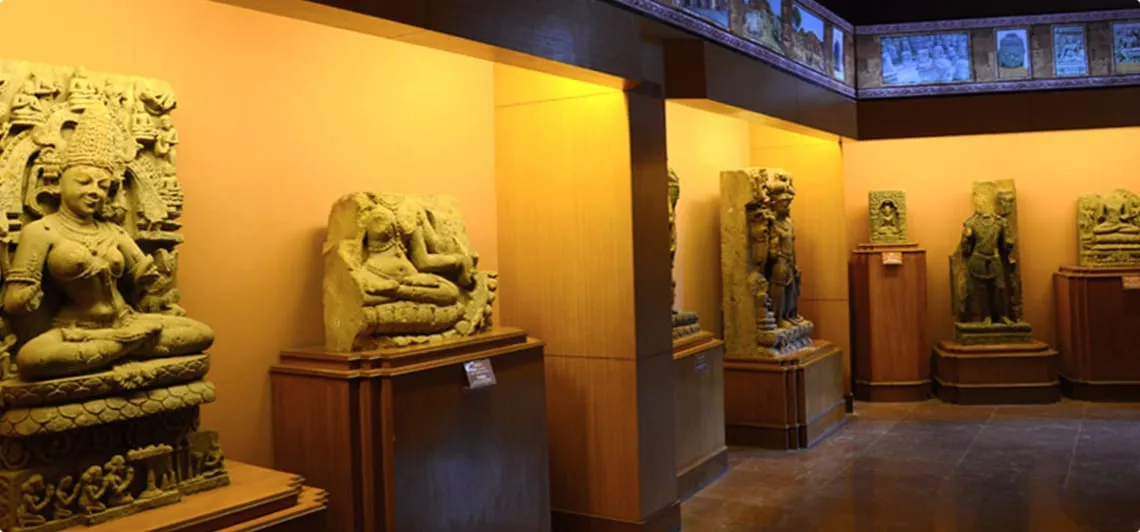
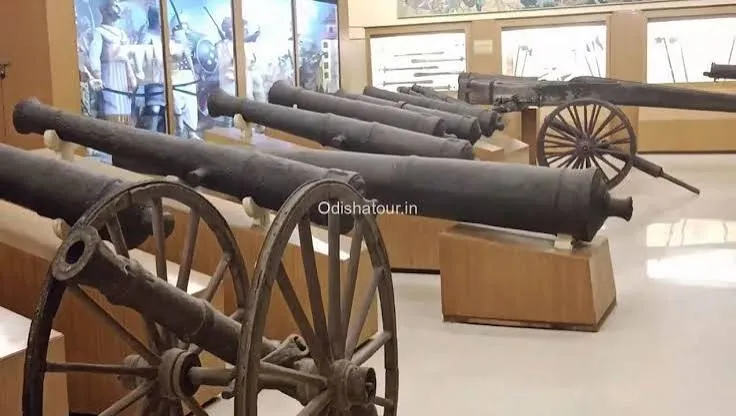
Today the museum, managed by the state’s Cultural Affairs Department, has grown to 11 specialised sections holding more than 56,000 antiquities. Highlights include its Archaeology section (Buddhist, Jain and Brahmanical sculpture from Bhubaneswar, Puri and Konark, alongside relics from the Ratnagiri-Udayagiri-Lalitgiri Buddhist monastic sites), one of the world’s largest Palm Leaf Manuscript collections (over 50,000 texts, including an illustrated 1496 copy of the Abhinava Gita Govinda), an Epigraphy and Numismatics gallery of inscriptions and coins spanning the punch-marked, Kushana, Gupta and Ganga periods, and an Armoury and Natural History gallery. During its Platinum Jubilee in 2008, the museum added an outdoor sculpture garden, restored a set of Ganga-period stepwells, and opened a Maritime Heritage Gallery covering Kalinga’s historical trade links with Southeast Asia.
The Tribal Museum: From “Museum of Man” to Living Village
The Odisha State Tribal Museum began in 1953 as the “Museum of Man,” an anthropological research tool under the Scheduled Castes & Scheduled Tribes Research and Training Institute (SCSTRTI). It started as a single exhibition hall, holding field specimens, costumes and tools gathered by state anthropologists working in districts like Mayurbhanj, Koraput and Kandhamal — part of a broader post-independence effort to document tribal material culture before it was lost to rapid economic change.
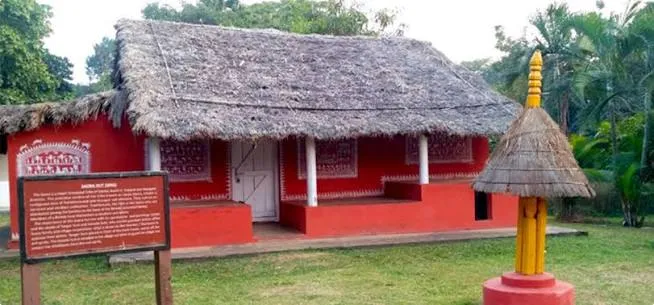
In 1986, the museum moved beyond indoor display cases, building five life-sized huts on its wooded campus representing the traditional housing of the Santal, Juang, Gadaba, Saora and Kondh communities, and displaying everyday tools and textiles inside these settings rather than behind glass. This “living museum” approach proved successful enough to justify a larger, dedicated building, which opened on 5 March 2001, combining indoor galleries with the outdoor architectural displays. In 2010, UNESCO recognised it as the finest of India’s 21 tribal research museums.
Tribal History and Ethnography Exhibits
The tribal collections offer an immersive look into the lifestyles, spiritual beliefs, and artistic expressions of Odisha’s indigenous groups, who make up over 22% of the state’s population, including 13 Particularly Vulnerable Tribal Groups (PVTGs).
| Gallery | Exhibits | Represented communities |
|---|---|---|
| Ornaments & Adornment | Brass, bell-metal and silver torques; bead necklaces and ear ornaments | Bonda, Gadaba, Kondh, Santhal |
| Costumes & Textiles | Hand-woven garments from single-heddle back-strap looms with geometric patterns | Bonda (Ringga cloth), Dongria Kondh (Kapthagunda shawls) |
| Agricultural & Hunting Tools | Iron-tipped arrows, battleaxes (tangis), bird traps, wooden plows | Juang, Bhuyan, Ho |
| Household Crafts | Bamboo storage containers, seed bins, carved wooden doors, clay cookware | Munda, Oraon, Gond |
| Musical Instruments | Stringed kenendras, ceremonial drums, bamboo flutes | Santhal, Saora, Koya |
The Living Museum Concept: The experience extends outdoors with life-sized, authentic replicas of tribal huts built with traditional clay, thatch, and wall murals (such as Lanjia Saora art) to depict real living environments.
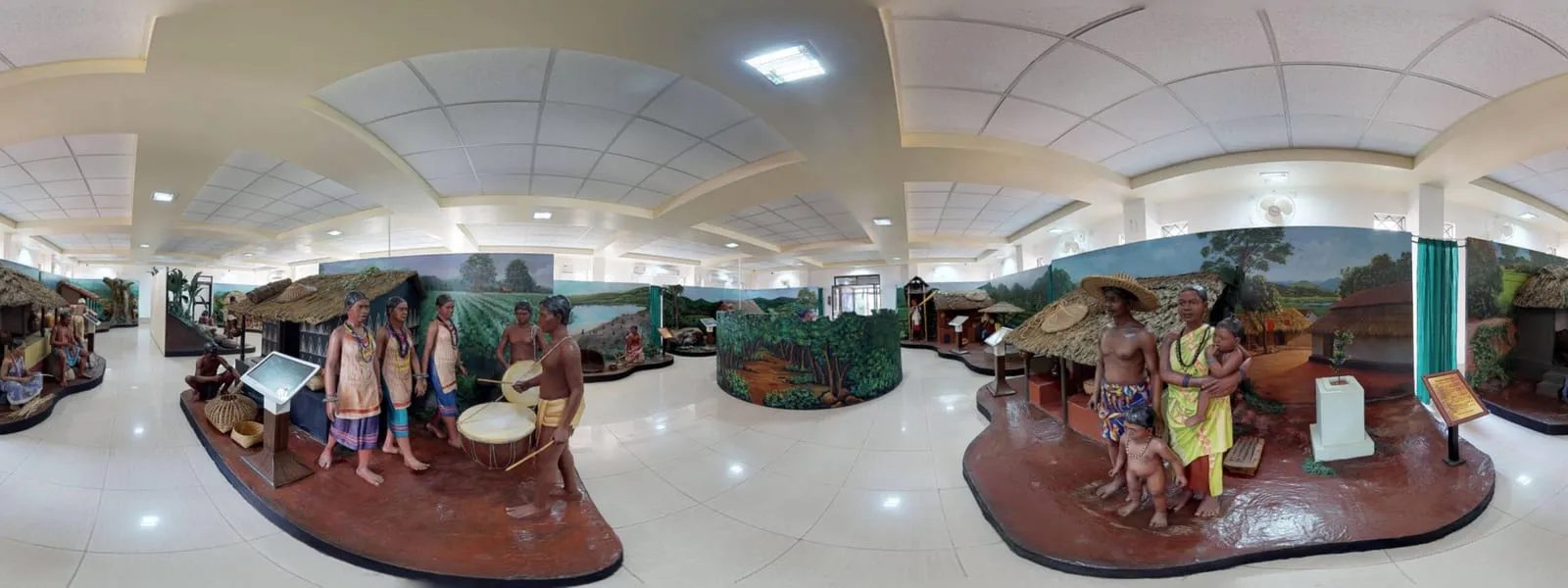
The PTG World Gallery is dedicated to Odisha’s 13 Particularly Vulnerable Tribal Groups, including the Birhor, Chuktia Bhunjia and Didayi, focusing on their livelihoods and belief systems. The museum also runs a Tribal Shrine Crafts arena, a food court serving traditional grains, a herbal garden of indigenous medicinal plants, and live demonstrations of crafts like Saora pictogram painting. Since August 2020, a digital interactive tour has also let visitors explore the galleries and archives remotely.
Maritime History & Kalinga’s Naval Legacy
Odisha’s maritime heritage focuses on the ancient kingdom of Kalinga, whose sailors traveled extensive trade routes to Sri Lanka, Java, Sumatra, Bali, and Borneo.
Sadhabas Trade Routes: Exhibits detail the history of the ancient Odia merchants (Sadhabas), mapping out how they utilized monsoon winds to trade spices, silks, fine pottery, and minerals across Southeast Asia.
Boita (Ship) Models: The museum displays structural models and artistic relief depictions of Boitas — the large, sturdy wooden vessels used for trans-oceanic voyages.
Cultural Footprints: Displays illustrate the profound socio-religious impact of Kalinga’s maritime trade, highlighting how Odia culture, architecture, and Buddhism integrated into the historical heritage of Southeast Asian regions.
Visiting Information & Planning
To explore these historical deep-dives, you can plan your visits using the standard details below:
| Feature | Odisha State Museum | Odisha State Tribal Museum |
|---|---|---|
| Location | Kalpana Square, BJB Nagar | CRPF Colony, Gopabandhu Nagar |
| Timings | Tuesday–Sunday: 10:00 AM – 5:30 PM (Closed Mondays) | Tuesday–Sunday: 10:00 AM – 5:30 PM (Closed Mondays) |
| Entry Fee | ₹10 for Indians, ₹100 for Foreigners | Free Admission |
| Key Highlight | Palm-leaf manuscripts, Kalinga architecture gallery, maritime lore | Life-sized tribal huts, live art demonstrations |
Plan your visit